How to Choose the Perfect Wedding Venue: 10 Things Couples Often Forget

Knowing how to choose a wedding venue is one of the most important skills any couple can develop early in the wedding planning process. Your venue sets the tone for the entire celebration, impacts your budget more than almost any other single decision, and shapes the experience of every guest who walks through the door.
Most couples approach wedding venue selection by focusing on the obvious questions — does it look beautiful, does it match our style, is it available on our date? But experienced wedding planners will tell you that the details couples consistently forget to check are almost always the ones that cause the most stress on the actual day.
This guide walks you through 10 critical things couples overlook when learning how to choose a wedding venue — so you can approach every site visit with confidence, ask the right questions, and make a decision you will feel great about long before the big day arrives.
Whatever your style, there’s a wedding venue to match it. Couples today choose from banquet halls, marriage gardens, garden wedding venues, outdoor wedding venues, resort wedding venues, farmhouse settings, and luxury wedding venues — as well as destination wedding venues in places like Udaipur, Goa, and Rajasthan for those planning a destination wedding in India. Whether you’re searching for wedding venues near you or scouting destination wedding locations in India, the fundamentals below apply to every type of venue.
How to Choose a Wedding Venue: 10 Things Couples Often Forget
1. The Realistic Guest Count — Not the Optimistic One

One of the first things to settle when figuring out how to choose a wedding venue is your actual guest count — not the number you hope for, but the number that is most likely. Most couples underestimate their final guest list. You start with 100, both families add their must-invites, colleagues get included, and suddenly you are at 180. A wedding venue that felt spacious at 120 guests becomes uncomfortably cramped — or simply cannot accommodate the final count at all.
What to do before any wedding venue booking:
- Sit down with both families and build a maximum possible guest list — not your ideal one
- Add a 15–20% buffer to that number to account for last-minute additions
- Ask venues for their comfortable capacity, not just their maximum — a banquet hall that fits 300 at full squeeze may comfortably seat only 220
- Confirm whether the capacity figure includes the dance floor, buffet area, bar, and stage — or whether those are counted separately from seated guests
Falling in love with a wedding venue before confirming it can hold your crowd is the single most common and most costly mistake couples make in the venue selection process.
2. The True All-In Cost — Hidden Charges and Add-Ons
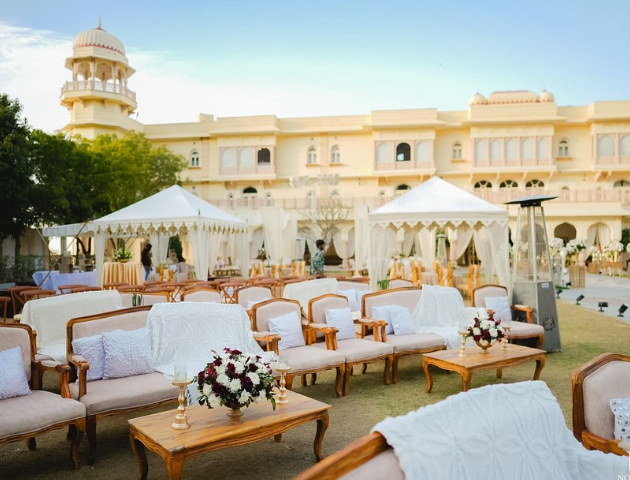
When learning how to choose a wedding venue, never budget based on the headline price. The quoted base rate is rarely the final cost. Many venues — from marriage halls to luxury wedding venues — operate on a base-rate model and charge separately for almost everything else. Couples who plan their wedding budget planning around the first figure they are given are frequently blindsided when the final invoice arrives.
Common hidden costs to ask about at every wedding venue:
- Mandatory in-house catering minimums
- Corkage fees if you bring your own alcohol
- External vendor surcharges for bringing your own caterer, decorator, or photographer
- Generator or power backup deposits
- Bridal suite or green room charges
- Parking, valet, or shuttle costs
- Overtime charges if your event runs past the contracted end time
- Security staff fees and cleaning or damage deposits
Request a fully itemised quote in writing that lists every possible add-on. Ask directly: “If our wedding runs exactly as planned, what is the total amount we would pay — including every fee?” Compare wedding venues on total cost, not just the base price. This is fundamental to smart wedding venue booking.
3. Vendor Restrictions and Approved Lists
Many wedding venues — particularly hotels and dedicated banquet halls — have strict policies on who you can and cannot hire. This is one of the most overlooked considerations when deciding how to choose a wedding venue. They may require you to use their in-house caterer, their empanelled decorator, or their preferred DJ. Bringing outside vendors may be prohibited outright or subject to significant surcharges that inflate your total cost.
Why this matters for your wedding venue checklist:
- You may already have a photographer or caterer in mind who is not on their approved list
- In-house vendors are often priced at a premium with less room for negotiation
- Approved vendor lists can limit your creative vision for décor, food, and entertainment
What to ask every luxury wedding venue or banquet hall: “Do you allow outside caterers, decorators, photographers, and entertainment? Is there a fee for using vendors not on your approved list? Can I see your list of empanelled vendors and their pricing?” If creative control matters to you, prioritise wedding venues that give you the freedom to bring your own team.
4. Lighting — At the Right Time of Day

A wedding venue can look entirely different depending on when you visit it. Natural light, artificial lighting rigs, and the surrounding environment all shift dramatically between morning, afternoon, and evening. Many couples visit wedding venues in the middle of the day and make their booking decision based on what they see — only to find the space feels completely different during their evening reception. This is a common blind spot in the how to choose a wedding venue process.
What to do before finalising your wedding venue booking:
- Schedule your venue visit at the same time of day as your planned event
- If you are planning an evening wedding, ask to see the venue after dark with all event lighting switched on
- Check whether the venue provides in-house lighting or whether you need to hire an external lighting vendor
- Ask to see photos or videos from past weddings held at the same time as yours
- Pay attention to how natural light moves through the space — windows, skylights, and open areas can create harsh shadows or glare at certain hours
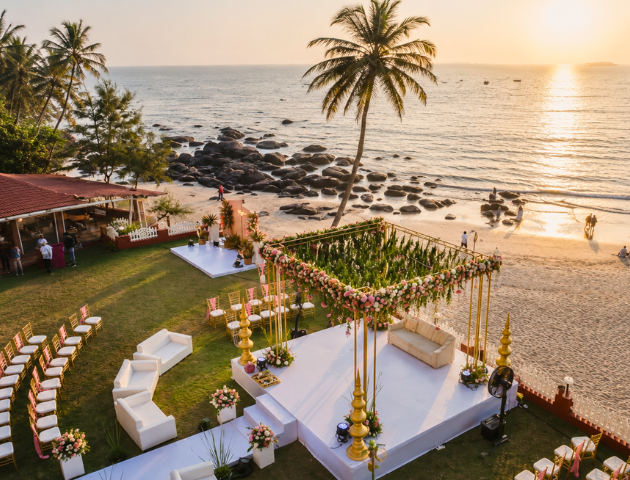
Lighting is one of the most powerful elements in wedding photography and overall ambience. For any outdoor wedding venue in India, pay particular attention to how the golden hour and evening light play across the space — it can be the difference between magical and mediocre photographs.
5. Acoustics and Sound Quality
Poor acoustics are one of the most overlooked — and most disruptive — problems in wedding venue selection. An echoey hall, a space with no sound system, or an outdoor wedding venue affected by traffic and wind noise can make speeches inaudible, music distorted, and vows completely impossible to hear. This is rarely on anyone’s wedding venue checklist, but it should always be.
What to assess during every wedding venue visit:
- Stand at the back of the ceremony space and speak at a normal volume — can you hear clearly?
- Ask about the venue’s in-house PA system — how many speakers, what areas they cover, and whether a sound engineer is available
- For outdoor wedding venues, ask how sound carries and whether ambient noise from traffic, neighbouring events, or wind has been an issue at past events
- Check whether there are noise curfews that might affect your music cut-off time
For larger gatherings especially, it is worth budgeting for a professional sound setup rather than relying on whatever the wedding venue provides by default. Add it to your wedding venue checklist before every site visit.
6. Weather Contingency and Backup Plans

No matter how predictable the weather typically is on your wedding date, every couple learning how to choose a wedding venue needs a backup plan. Outdoor and semi-outdoor wedding venues in India are particularly vulnerable — but even indoor wedding venues can face issues with power outages, flooding on access roads, or extreme heat with inadequate cooling. This consideration is especially important for couples planning a destination wedding in India or an outdoor garden ceremony.
Questions to ask every wedding venue about contingency planning:
- “What is your wet weather or contingency plan if it rains during an outdoor event?”
- “Is there a covered or indoor space that can be used if outdoor areas become unusable?”
- “How quickly can you transition the setup indoors if needed?”
- “Is air conditioning or heating available, and what is the capacity of the system?”
- “Does the venue have generator backup, and how long is the switchover time?”
Never assume good weather is guaranteed. Build contingency thinking into your wedding venue selection from the beginning — not as an afterthought after you have already signed the contract.
7. Accessibility for All Guests

Accessibility is frequently forgotten until it becomes a problem on the actual wedding day. A wedding venue may look stunning on Instagram but be practically difficult for elderly guests, guests with mobility challenges, pregnant guests, or families with young children. When thinking about how to choose a wedding venue, always walk it through the eyes of every type of guest you are inviting.
What to check on your wedding venue checklist for accessibility:
- Is there step-free or ramp access from the entrance to all areas of the event space?
- Are there lifts if the wedding venue is on multiple floors?
- Are the restrooms accessible and conveniently located?
- Is there adequate seating in all areas for guests who cannot stand for extended periods?
- How far is the parking or drop-off area from the main entrance?
Walk the entire venue path from arrival to ceremony to reception as if you were a guest with limited mobility. If any section presents a challenge, ask the wedding venue coordinator how they accommodate it. Ensuring that every guest — regardless of age or physical ability — can participate fully and comfortably is one of the most important and most overlooked aspects of wedding venue selection.
8. Parking, Transport, and Guest Logistics
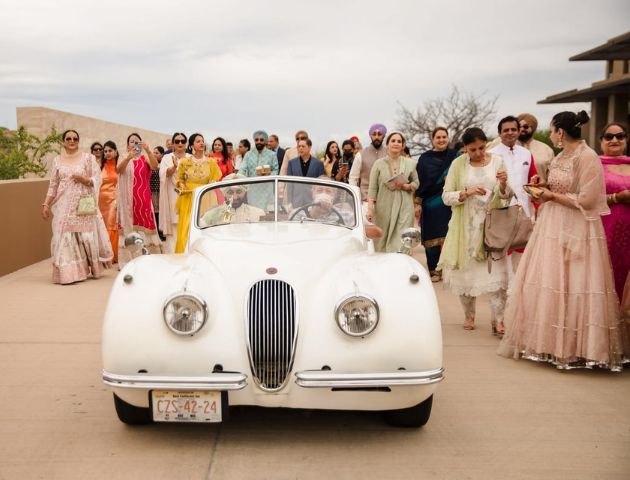
Parking and transport logistics have a direct impact on how smoothly your wedding runs. A wedding venue that is hard to reach, has limited parking, or is not well-connected by public transport can lead to late arrivals, stressed guests, and a delayed start. This is an area where many couples skip the difficult questions when learning how to choose a wedding venue — and pay for it on the day.
What to assess as part of your wedding venue checklist:
- How many vehicles can the venue’s own parking accommodate?
- Is there overflow parking nearby — and is it safe and well-lit for evening events?
- Is the wedding venue easily accessible by public transport, auto, or cab services?
- If you have guests staying at nearby hotels, how far are the closest accommodation options?
- Is there a designated drop-off and pick-up zone for taxis and rideshares?
- For large events, does the venue have a relationship with nearby parking lots or shuttle services?
Providing guests with clear arrival instructions, parking guidance, and hotel recommendations well in advance can significantly reduce the chaos on the day. For destination wedding planning in India, this consideration becomes even more critical — most guests will be arriving from out of town and need full logistical support.
9. Catering Capacity and Food Service Flow
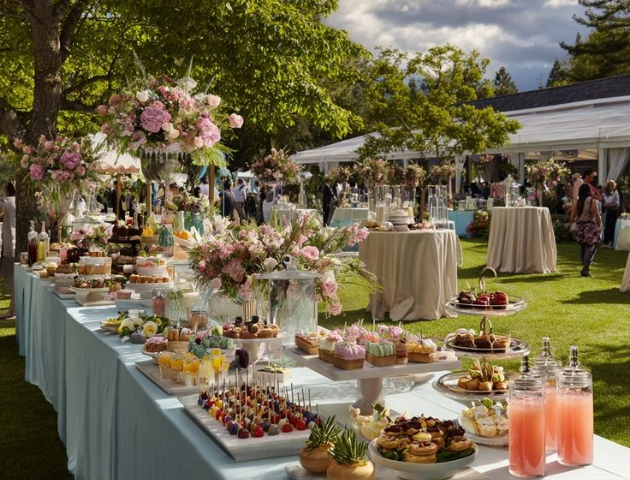
Even when the food itself is excellent, poor service flow can leave guests waiting, hungry, and frustrated. This is a dimension of wedding venue selection that couples rarely explore in depth. A venue’s kitchen and service staff may not be equipped to handle your full guest count efficiently — particularly for large gatherings with multiple courses, live cooking stations, or an elaborate spread across several food stations.
What to ask about catering operations as part of your wedding venue booking process:
- How many guests can the kitchen realistically serve in a single service without significant delays?
- What is the staff-to-guest ratio for your event?
- How will the food service flow work — buffet, plated service, or food stations?
- What is the contingency if a dish runs short or a station becomes overcrowded?
- Are dietary requirements — vegetarian, vegan, gluten-free, allergies — something the kitchen is experienced in handling?
- How many tasting sessions are included before the wedding day?
If you are using an external caterer, confirm whether the wedding venue’s kitchen is equipped to support their setup and whether there are any kitchen access fees or restrictions. These details belong on every wedding venue checklist without exception.
10. The Contract Details and Cancellation Policy

One of the most important — and most skimmed — parts of the wedding venue booking process is the contract itself. Many couples sign quickly in the excitement of finding what feels like the perfect place, only to discover later that the terms do not protect them as well as they assumed. If you want to know how to choose a wedding venue that is truly the right fit, read every line of the contract before you commit.
Key contract clauses to review carefully before any wedding venue booking:
- Cancellation and refund policy — what happens to your deposit if you cancel? What if the venue cancels on you?
- Force majeure clause — are you protected in cases of natural disasters, government restrictions, or other unforeseen events?
- Date change policy — if you need to shift your date, what are the conditions and costs?
- Final payment timeline — when is the balance due, and what are the penalties for late payment?
- Damage liability — who is responsible if something is damaged during the event?
- Capacity and layout — is the agreed capacity and layout documented in writing within the contract?
- Vendor access and timing — when can your vendors access the wedding venue for setup, and until what time?
Always have someone — ideally a lawyer or experienced professional wedding coordinator — review the contract before signing. Verbal promises made during a wedding venue tour mean nothing once you are committed on paper. This is non-negotiable advice for any couple working through how to choose a wedding venue the right way.
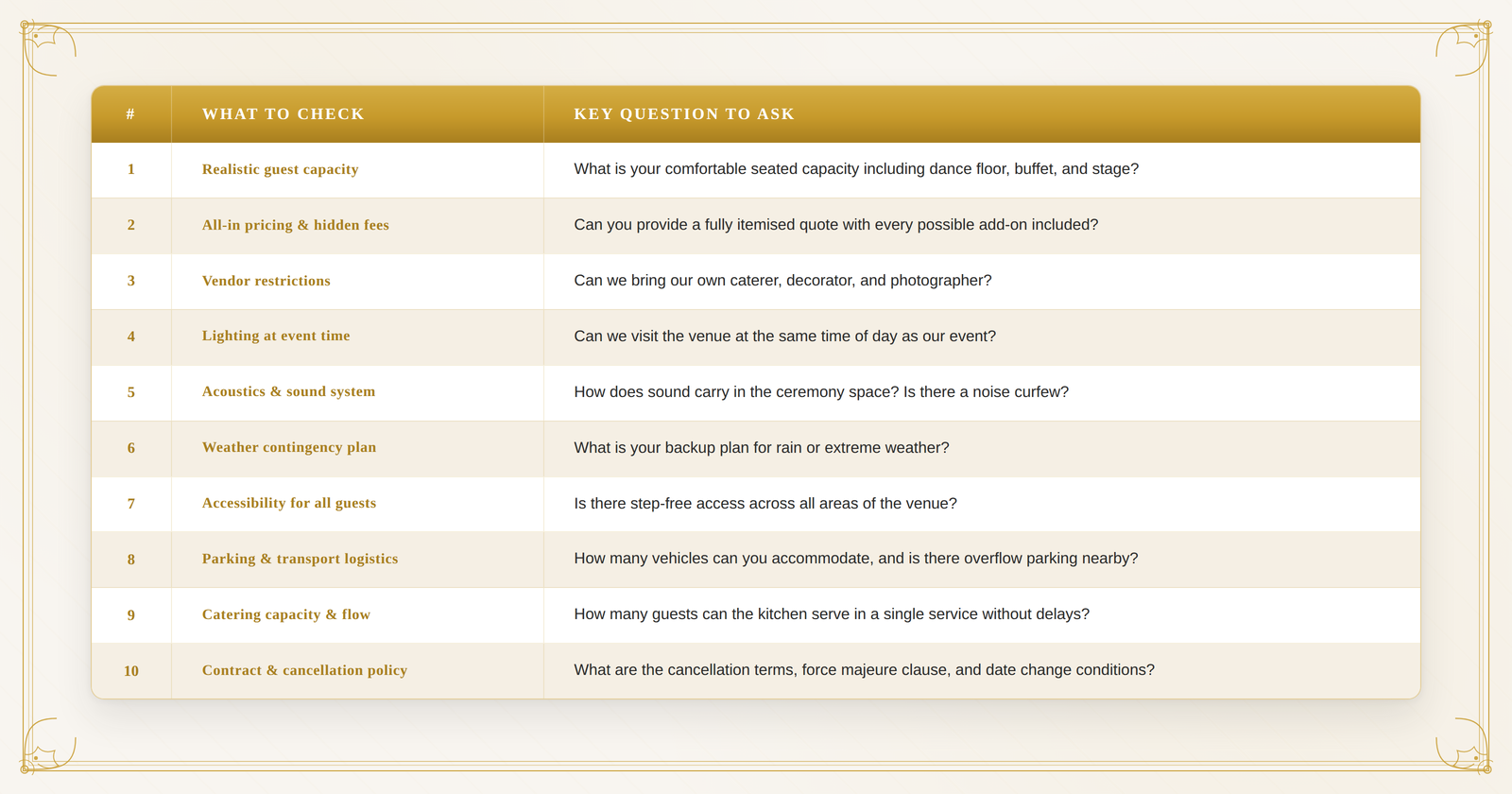
Wedding Venue Checklist: Quick Reference
Use this at-a-glance wedding venue checklist on every site visit so you never miss a critical question:
Frequently Asked Questions: How to Choose a Wedding Venue
How far in advance should I book my wedding venue? For most wedding venues in India, especially luxury wedding venue options and popular banquet halls, you should begin your wedding venue booking process at least 12 months before your wedding date. For peak season dates between November and February, the best wedding venues are frequently booked 12 to 18 months in advance. Start your search early and always visit shortlisted venues in person before committing.
What is the most important item on a wedding venue checklist? Guest capacity is the most foundational item on any wedding venue checklist. Every other planning decision — catering quantities, seating layout, entertainment setup, and décor budget — flows from your confirmed guest count. If the venue cannot comfortably accommodate your actual headcount, no other feature makes it the right choice, regardless of how beautiful it looks.
What hidden costs should I watch out for in wedding venue booking? The most common hidden costs in wedding venue booking include mandatory catering minimums, external vendor surcharges, corkage fees, generator backup charges, bridal suite fees, overtime charges, and damage deposits. Always request a fully itemised quote in writing and ask for the total all-in cost before making any commitment. This is one of the most practical tips for anyone learning how to choose a wedding venue in India.
Is an outdoor wedding venue in India a good choice? An outdoor wedding venue in India can be breathtaking — especially for winter weddings between October and February when the weather is mild and predictable. However, outdoor wedding venues in India require a robust weather contingency plan, a clear sound management strategy, strong generator backup, and careful logistical planning for guest transport and parking. Always confirm the backup plan before signing the wedding venue booking contract.
Do I need a wedding planner to help choose a venue? While you can research and visit wedding venues independently, a professional wedding planner dramatically simplifies the process. Planners have direct relationships with the best wedding venues across your city, negotiate better rates on your behalf, know exactly what questions to ask during site visits, and review contracts with an experienced eye. If you are planning a luxury wedding venue experience or a destination wedding in India, having a professional in your corner during venue selection is especially valuable.
What types of wedding venues are most popular in India? Couples in India choose from a wide range of wedding venues depending on their guest count, budget, and vision — from banquet halls and marriage gardens to resort wedding venues, farmhouse settings, and palace-style luxury wedding venues. Garden wedding venues and outdoor wedding venues remain popular for winter dates, while destination wedding venues in Udaipur, Jaipur, Goa, and Rajasthan continue to be top choices for couples planning a destination wedding in India.
Explore More from ConnectX Events
→ Our Services: Discover our full range of luxury wedding and event services
→ Get in Touch: Book a free consultation with our wedding planning team
Final Thoughts
The perfect wedding venue is not simply the most beautiful one — it is the one that fits your real guest count, respects your total budget, supports your vendor choices, provides a credible contingency plan, and runs smoothly from the first guest arrival to the last farewell.
The couples who are happiest with their wedding venue choice are the ones who knew how to choose a wedding venue properly — who asked the difficult questions before signing, who walked through the space with a comprehensive wedding venue checklist in hand, and who took nothing for granted.
Use this guide every time you visit a potential wedding venue. Take notes. Compare honestly. And when you find the wedding venue that ticks every box on your checklist and simply feels right — that is where your wedding belongs.
Found this wedding venue checklist helpful? Share it with a couple who is just starting their venue search — the right questions asked early save an enormous amount of stress later.